Tuesday, April 28, 2009

Socialist Lavatory League, Bulletin 6


A highly worthwhile contribution to the proceedings from The Institute, who reminds us how important public toilets are to the achievement of full Communism, quoting Lenin thus:

When we are victorious on a world scale I think we shall use gold for the purpose of building public lavatories in the streets of some of the largest cities of the world. This would be the most “just” and most educational way of utilising gold for the benefit of these generations which have not forgotten how, for the sake of gold, ten million men were killed and thirty million maimed in the “great war for freedom”, the war of 1914-18, the war that was waged to decide the great question of which peace was the worst, that of Brest or that of Versailles; and how, for the sake of this same gold, they certainly intend to kill twenty million men and to maim sixty million in a war, say, in 1925, or 1928, between, say, Japan and the U.S.A., or between Britain and the U.S.A., or something like that. But however “just”, useful, or humane it would be to utilise gold for this purpose, we nevertheless say that we must work for another decade or two with the same intensity and with the same success as in the 1917-21 period, only in a much wider field, in order to reach this state.

He also sends me further proceedings, which suggests, irrespective of the undeniable achivements of the Cuban revolution, that its dubiousness does not stop at homophobia and dynastic succession. Guevara, proving his hostility to the righteous cause of the Socialist Lavatory League, thus:

It is a bit like... I do not know, but I would almost classify it as a colonial mentality. I get the impression they are thinking of making the latrine the fundamental thing. That would improve the social conditions of the poor Indian, of the poor Black, of the poor person who lives in subhuman conditions. “Let's make latrines for them and after we have made latrines for them, and after their education has taught them how to keep themselves clean, then they can enjoy the benefits of production.” Because it should be noted, distinguished delegates, that the topic of industrialization does not figure in the analysis of the distinguished experts. Planning for the gentlemen experts is the planning of latrines. As for the rest, who knows how it will be done!

If the president will allow me, I will express my deepest regrets in the name of the Cuban delegation for the loss of the services of such an efficient specialist as the one who directed this first group, Dr. Felipe Pazos. With his intelligence and capacity for work, and with our revolutionary activity, within two years Cuba could have become the paradise of the latrine, even if we did not have a single one of the 250 factories that we are beginning to build, even if we had not carried out the agrarian reform.

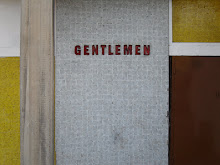
Image via, and previous proceedings of the League here.

Saturday, June 10, 2006

Socialist Lavatory League


Somewhere in the 1970s diaries of enthusiastic sadist, critic, buttock fetishist (most memorably, viz: 'the buttocks are the most aesthetically pleasing part of the body because they are non-functional. Although they conceal an essential orifice, these pointless globes are as near as the human form can ever come to abstract art')_ and first person to say 'fuck' on telly Kenneth Tynan, is a recounting of a dream of the 'socialist lavatory league', a clandestine revolutionary organisation dedicated to the collectivisation of toilets. A utopia in which the very concept of the 'private toilet' is abolished. This is perhaps a situation as close to paradise as any I could imagine.


Walk round London and you can't fail to notice at specific points huge, gothic, palatial public toilets. You also can't fail to notice that they have, invariably, been closed down. Its as if capitalism is now hurtling back to a time before even the public amenities of the 1860s. This being, for reasons connected with the rather unpleasant chronic disease from which I suffer, a subject close to my heart. Grotesquely, Central London is beset with public amenities that only allow standing room- space age pods with automatic doors, rarely if ever open, a perfect demonstration of an allegedly dynamic system incapable of providing even the simplicities of a cistern.

So then comrades, I propose we re-open the toilets, smash the gates, go door to door in Hampstead and demand at gun point the use of their facilities! Incontinents of the world unite, you have nothing to empty but your bowel!

Wednesday, August 12, 2009

Socialist Lavatory League Communique #7


The attention of the SLL has been drawn to the following proposals for Tomorrow's Public Toilet, organised by that monarchist claque, the RIBA. The League applauds the rare attention to Public Convenience, something which has been all-but obliterated in the neoliberal city, with the privatised, revanchist exceptions of those automated pods where 20p ushers you into a machine around as trustworthy as the hospital bed in Roujin-Z. Worse still are those pissoirs where those - like the League's General Secretary - who have major problems with the plumbing, are left wholly dispossessed. At the very least, these proposals appear to have full facilities and an attention to aesthetics which is welcome - we cannot live by receptacles alone. For this at least, these architects must be applauded.


However, all of the contributors here - most of whom seem to accept the preposterous notion of paying to use public facilities for relief - make a common mistake. They all seem to think, in a giggly English fashion (and Eva Jiricna doesn't even have that excuse) that bodily functions are funny, and that this hilarity must be communicated by the form. Now, as many members of the SLL find that their dignity is put at risk for health and other reasons, the ideal of the public convenience will always be one of clean living in difficult circumstances. There's no reason why a loo should resemble an early 70s Terry Gilliam animation or one of the adverts from Bert Fegg's Nasty Book for Boys and Girls. Regardless, the proposals, one by one: Jiricna is already partly responsible for one public loo in London, at her Canada Water bus station. Being part of the freakish, anomalous brilliance of the Jubilee Line extension, the station itself is a marvellous Constructivist pavilion, but the toilets actually go too far in the other direction. No offensive jollity, but instead a Bottom Inspectors hell of cold metallic cisterns. Notably, none of the Jubilee Stations' toilets have seats, presumably because TFL can't be bothered to replace them after they get vandalised. That this great public project eventually results in sitting on cold metal in a London winter is an example of the limits of reformism.


So Jiricna's contribution here is brightly coloured, which immediately makes it unlike her earlier work. There is a big cartoon flower in the middle, a touch of fashionable eco-whimsy which is replicated in the programme: There is also the option of pods that provide undercover seating, advertisements, video projection and vending machines, not to mention solar batteries, wind turbines or light sculptures. Public art in public conveniences. We can pass over Robert Adam's neoclassical proposal, not only because lamentably reactionary but also because it is nothing new - similar royalist pissing pods are sprinkled around Westminster, and all of them adhere to the automated pod design which is the enemy of true Public Convenience. Will Alsop's proposal is somewhat baffling - is he suggesting, in Swiftian fashion, that the smell of our waste should be left to linger on the concrete streets? Are we lifted into the toilet's pod or is the toilet hoisted onto us? So his attention to ventilation is most welcome, removing the smell of either disinfectant or piss that is usually attendant, his technological formalism (not to mention the whimsical Zebra stripes) is, while intriguing, something likely to result, after the usual minimal attention to maintenance, in the toilet pod crashing somewhere that it shouldn't.


The other two, and superficially similar proposals, by DSDHA and FAT, don't seem that interested in the immanent qualities of the public toilet, but are more about particular urban interventions using the loo as a pretext. DSDHA go for a Cesare Borgia fountain, all Gods, Goddesses and 'greywater' turned into a pretext for water features. This, at least, is staffed, although the 'warden' appears a rather Bottom Inspectors choice - a mere attendant is obviously not sufficiently security conscious. The 'elevation' promised is deeply ideological - the elevation of the act of expulsion to the level of myth is the mere correspondent of its denigration. It need not be either, just something that has to be done, cleanly and comfortably. A similarly grandiose design by FAT, featuring a gigantic head of Hercules and/or Athena (the proposal that Aphrodite could replace the latter is at least intriguing) recognises that our 'miserly public toilet provision' must be fought, but also seems to go too far in the other direction, proposing instead an intimidating grandiosity, though it's a more interesting urban object than any of the other proposals, with the possible exception of Alsop's. It shares with all of them the recourse to the gag. If there is any form of public architecture where a certain amount of rectitude and lack of fuss would be necessary it is this, yet all of these architects are more inclined to chuckle schoolboyishly. Another effort, architects, if you want support from the SLL.

(in the course of researching this I was forwarded the following link, which includes a rather funereal loo by Adolf Loos - a man who knew that plumbing is a very serious thing)

Tuesday, August 05, 2008

Socialist Lavatory League, Bulletin #5


Comrade Bhattacharyya sends for the League's perusal the following proceedings: a debate, started by Mike Haynes, between historians and other interested parties on the use of toilet paper before and after the collapse of the Soviet Union. Neither come off particularly well, but it's comforting that so many people found an appropriate use for the pages of Pravda, not to mention the collected works of Stalin, translated into Kirgiz. Further proceedings here.

Thursday, November 04, 2010

Flyovers


'Nothing in this world develops absolutely evenly; we must oppose the theory of even development or the theory of equilibrium.'
Mao Zedong, 'On Contradiction', 1937

First of what will be several Shanghai posts over the next week or so, to try and avoid the gigantic-post-which-nobody-reads problem of an earlier excursion to Moscow. Thanks are due to Justin O'Connor, Chris Connery and Ma Haili.


There is a theory about the People's Republic of China, voiced most recently in Boris Groys' intriguing, if historically nonsensical The Communist Postscript, that what seems like merely the administration of capitalism by an oligarchy that is a Communist Party in nothing but name, is actually a gigantic, prolonged version of the New Economic Policy embarked upon by the Bolsheviks throughout the 1920s – the use of a dirigiste, state-planned capitalism to build up productive forces to a level where the population has gone from being poor to being reasonably comfortable, after which the Communist Party could take command of this wealth and use it for the building of full Communism, something which can, after all, in 'stage' theory only be achieved after the development of a mature industrial capitalism. This is at least what Deng Xiaoping always claimed was going on.


And this stage of 'building up the productive forces' has lasted thirty years - why not? Lenin, for instance, clearly envisaged that NEP would last a lot longer than the 8 years it got before it was replaced by Stalin's forced collectivisation, chaotic industrialisation and total suppression of private commerce. If we make what seems – with good reason – to be a rather extravagant theoretical leap, and see this as a super-NEP, what could the future Communist China do with the hypercapitalist infrastructure, the gated communities, the skyscraping office blocks, of the largest Chinese (and, in terms of 'city proper', largest world) city? One symptomatic question is – if, as is often claimed, China is making the world's biggest investment in green technology, then what are they going to do with all those flyovers?


Shanghai is laced with elevated roads, all built over the last ten years or so, at roughly the same time, but to rather more impressive effect, as the Metro system. That system of private transport is very nice, but aesthetically forgettable; this system of flyovers is monstrous, dominant and utterly unforgettable. Chris Connery, who is showing me round the city on my second day here, tells me of a conversation he had with a Party member, on the (apparently still extant) left-wing of the CCP. When global warming really hits, when the oil runs out, and the use of the car has to be curbed, what will the Party do with all this? Can they just ban people from driving? Will people accept it? Yes, was the reply, but the Party merely lacks the will. So before I had even seen these constructions, I had in mind the idea of them cleared of the traffic which is too thick and dense even for their astonishing capaciousness, with bicycles and walkers making their way along these lofty elevated roads. They're one of the most impressive works of engineering I've ever seen, for the less than impressive function of moving the private car with its internal combustion engine from A to B – though, at least for the moment, taxis are so abundant and so cheap, sometimes equalling the levels of private cars, that to call it wholly 'private' feels a minor misnomer.


After driving along and under a few of them in a dazed, numb state when off the plane, the first of these flyovers that I really saw was in a working class district in the north of the city, near Caoyang New Village, a 1950s housing development which Chris was showing to his students. The area around it was so impossibly dense, the width of its expressways so yawning, the clusters of towers so high, the metro station toilets so abject (the PRC's inegalitarian public convenience policy receives a severe reprimand from the Socialist Lavatory League – in an area where there are likely to be westerners present the loos are impeccable, elsewhere they're some of the worst I've ever seen) and the crowds so massive that I simply gave up and went back to bed, taking the photograph above of two towers seemingly being eaten by the flyovers before passing out.


Much of my time in Shanghai was spent commuting from the centre to the suburban campus of Jiaotong University (subject of a future post), so I saw some of the infrastructure in the areas where outsiders aren't generally looking. While the flyovers in the centre have the smoothest-finished cream concrete you're ever likely to see, here it's a much more standard material. They still tend to be rather dominant, but they're not meant to be looked at, and they travel through what is still a heavily industrial landscape, with huge factories on either side of the motorway. While some flyovers are meant for spectacle, these don't feel like they're meant for people at all, instead inducing the feeling of being a vulnerable fleshy part of a metallic network of freight, lessened only by the all-too-human aggressive driving that is ubiquitous here. There was one horrible moment on one of these expressways where various container lorries constantly overtook each other, manoeuvring into position to the point where it seemed as if they were actually intent on crushing the pathetic little car we were in. But, as I said, many of the flyovers really are meant to be seen.


Above, you can see one of the flyovers rising gingerly in the vicinity of some 1920s courtyard housing, which will also be the subject of the later post, but it's a mere preparation for what comes next.


Near People's Square, the former racetrack for the Europeans transformed post-revolution into a large public plaza, there's some sort of flyover convention, an intersection which is less spaghetti junction and more the intestines of a terrifying mythological beast. These sorts of organic metaphors tend to come to mind here, because there's little rationalistic or machinic about this place. Anyway – the three images above are there mainly to indicate the sheer, unnecessary height of these things. Note not only how the concrete itself is of the very highest grade, but also how there is planting running half the way up the concrete pillars, an effort at civic beautification which is visible mainly to the pedestrian, more than to the driver. Presumably this is there as a gesture to The Harmonious Society, with nature intersecting with technology in non-antagonistic manner, but it's far more like the engineers kept in mind the possibility that sooner rather than later these monuments will be obsolete, so made them pre-ruined, with picturesque vegetation creeping up them to simulate what they might look like when they've fallen into desuetude.


They also serve to frame the skyscrapers around, to delineate them, present them in their best light, to let them be seen from a contemplative distance, which gives a futurist flash to what can often seem crushingly dense and badly made on closer inspection. Except that's the sort of thing only noticed later on – you don't notice the details. When I first saw this intersection, I was absolutely frozen in awe, and then impressed by the fact that everyone else seemed entirely used to it, that it had become normal, just something you'd cross under on the way to work. There's a general ability to seem completely unbothered by what feels like a bloody steamroller of gigantism and force here which is admirable, although slightly worrying....Groping around for comparisons, the nearest thing seems to be the spidery expressways of Los Angeles - but those course through a low-density suburban sprawl, rather than charging through super-dense conglomerations of competing skyscrapers. But here too, any putative Reyner Banham would probably find that the flyovers are the main event, works of public infrastructure more impressive than the baubles on top of the towers of capital. Their forcing through areas of already huge density necessitates an extra pedestrian layer being inserted into them – there's plenty of these intersections that have pedestrian walkways running across, such as the blue steel and glass pedway sandwiched between the roads in the last of the pictures above. There you can also see a pillar with some dragons on, which as I recall is some sort of tribute to the non-human forces that made this intersection possible.


Yet throughout Shanghai, and here especially, it's hard not to wonder – how does this work, how does this sustain itself, and how do you get to the point where you're entirely blase about all this? Looking up at the flyovers, I'm as completely at a loss to get any impression of how all this works as I would be looking at an electrical diagram. Look at the second of the two pictures above – I'm only capable of interpreting it as an abstract sculpture or as a shocking biomorphic organism – a potentially lethal one, in both cases - but not as a road, I'd have to live here for a while for that prosaic familiarity to come. In terms of confrontation with an alien and awesome modernity, I feel here like the proverbial European visitor to New York or Chicago around 1920; the components of this cityscape are all familiar, there's no objects or forms I haven't seen before, but all of them have transformed into monstrous and illegible new combinations. There's all manner of fallacies the European in Shanghai can fall into, either of uncritical awe or knee-jerk repulsion, and I was at various points subject to both in my ten days there. This post is all about the awe, the repulsion will come in later, hopefully also with something less predictable. So – awe.


Keep the not-so-small nature of combined and uneven development out of your head for a moment, and the 'Shanghai as the Future' argument is the most seductive one of all the potential futures on offer in the dubious field of architectural futurology. To the untrained eye – very untrained – this seems the more preferable future city, more than the hooray-for-shanty-towns strain or the isn't-Dubai-like-super-interesting strain; the Foxconn factory in Shenzhen is a long way from the centre of Shanghai, and the ugliness of primitive accumulation is less immediately apparent; and I didn't see anyone sleeping under these flyovers. But the real reason why Shanghai-as-the-future is so convincing is because it looks like you imagined the future would look like when you were 14 years old. If the primary coloured wipe-clean architecture of New Labour Britain was designed by and for overgrown infants, Shanghai seems to have been designed by and for overgrown adolescent boys.


It's as if the engineers, architects and planners watched Akira and, rather than, say, picking Richard Rogers' plans for Pudong, looked at the dystopian animated city and thought 'hmm, let's build that instead.' We'd be fools not to indulge the disappointed teenagers who hoped the 21st century would be a damn sight more aesthetically invigorating than Greenwich Millennium Village. If you feel you've been denied the future, then to find it elsewhere looking exactly like you expected is a little uncanny. Disappointing, if you thought the future should be qualitatively rather than quantitatively different from the past. Yet Shanghai's sheer revelling in its own modernity is very difficult to resist, at first, and it's most difficult to resist when you travel along the flyovers at night. It doesn't seem to have a function, this lighting. 'What's this for?' I ask Chris, somewhat taken aback. 'Aesthetics!' he answers.


For the moment, then, let's completely abandon any critical edge and just salute the preposterous place, stare in abandonment at a city which lines its fucking flyovers in endless strips of blue neon at night, that makes the mundane act of driving into an abstract procession of light and geometry, that intensifies the process of commuting into this outrageous onrush of non-objective sensation. There are apparently a lot of car crashes in Shanghai.


You eventually reach ground level at something like this, with pedestrian walkways cutting across neon-lit geodesic domes, skyscrapers with searchlights cutting through the ubiquitous fog, and some rather familiar corporate logos. This massive project of state-built infrastructure is the less trumpeted of the major public works in the city. There's the Metro, of course, with nine underground lines built in the time it takes to string a tram line from one side of Manchester to the other, but there's also the Maglev magnetic levitation train. I didn't take it, although by all accounts it's marvellous, for the main reason that it gets you – at record-breaking speed! - from the airport to the tabula rasa business district in Pudong, which was not where I was going. The Maglev might be the one area where the prolonged NEP of the People's Republic entailed doing something differently, where it put a genuinely advanced technology at the service of a public, rather than private means of transport, but compared with these monuments to the hope, as P.J O'Rourke delightfully puts it, that 1.3 billion people get a Buick, it seems paltry indeed.

Tuesday, July 22, 2008

Bulletin No. 4 of the Socialist Lavatory League


Of the thirty-three million water closets in Great Britain, no more than 157,000 are municipally owned – a puny enclave of socialism in its minimal-ideal sense – inhabiting the sclerosed superstructures of civil society. The gross majority of the remainder are dispersed in single household dwelling units. Only in certain areas of Glasgow, Liverpool and the North are communal excretory facilities maximally available in private dwellings – a tribute to the massive, homogenous corporate posteriority of the older working class. For the rest, the global privatisation of the means of excretion radically destructures and factually granulates the ascendant historical bloc. No more subtle and pervasive generation of ‘bad faith’ could be envisaged than this perpetual serialisation, in which living individuals periodically retire from the world of pulsating intersubjectivity into a solitary absence.

Of course, I find myself in agreement with much of this. Curiously, a previous bulletin of the S.L.L derived in some way from Perry Anderson. A true friend of the Comrade caught short.
ta to Savonarola for this one.

Tuesday, May 19, 2009

Round-up


A disconnected collection of links, with a vaguely unifying thread of corruption, architecture and surveillance. First, K-Punk on vintage form, on Alan J Pakula, business ethics and individualism.
Another link pertinent to the proceedings of the Socialist Lavatory League: Jim Schembri calls for a people's movement to reclaim the public loo. The critique of the atomised, automated idiocy of those single toilet pods is particularly sharp; a typically inconvenient neoliberal approach to the public convenience, created in order to efface the worrying collectivity of the truly public pissoirs and cubicles of our Victorian forbears. The public loo must be truly public, or it is nothing at all.
Shockingly enough, an interesting article in Blueprint - Peter Kelly on what has happened to architecture in Rome since the Mayorship was taken over by a 'post-fascist' whose victory was famously greeted by ah, 'Roman salutes'. Unsurprisingly, practically any modern construction has been halted, although it seems that, understandably, nobody is remotely interested in defending the corrupt, neoliberal legacy of former mayor (and Sinistra Invertebrate) Walter Veltroni, rather bafflingly here described as 'left-wing'.


At OpenDemocracy, prolific architectural photographer and historian Edward Denison on The Architectural Photographer as Terrorist - he was recently detained under the Prevention of Terrorism Act, for the crime of photographing a neo-Georgian police station.
City of Sound on the lack of ambient noise provided by the electric car, something which some lobbyists are rather appallingly planning to rectify by adding traffic noise. COS has some rather more interesting aural suggestions.
Nothing To See Here on Marine Court, the hulking concrete cruiseship which is currently second home to Iain Sinclair, who writes about it with typical overheated noir paranoia here.
More corruption, evil and skulduggery and its occasionally tectonically intriguing results: a photoset of John Poulson's still derelict Leeds International Pool. Brilliantly odd and clearly a film-set in waiting, although not answering the enormously pertinent question of who the Blair boom's John Poulson might be. Hmmm.

Friday, March 07, 2008

Bulletin of the Socialist Lavatory League, No. 3


New Labour attempts to privatise the public loo. In reaction to this Third Way bollocks, with its public-private partnerships for pay-as-you-go receptacles, I propose a version of the mass trespasses of the 30s, in which those with 'irregularities' - Crohn's and colitis sufferers, the elderly, the heavily pregnant - smash open the iron gates of the Victorian palaces of expulsion and take a satisfying and much needed use of the amenities. I suggest we start at that one in Bermondsey round by the Antiques Market. If that fails, then knocking on the doors of the nearby Yuppiedromes threatening dirty protests if they don't open up their internal facilities should suffice.

Friday, August 28, 2009

Theory/Practice


Been away in The Capital Of Europe for a week, and a post or several about this experience should be on the way soon, but in the interim, here's a shortish piece for 3:AM on Verso's Radical Thinkers series. In terms of the praxis/talking question, the Climate Camp have set up er, camp on the heath where the revolting peasants used to assemble before descending upon the capital - and about a ten minute walk from my flat. I shall most certainly be partaking as soon as I get all the deadlines I accumulated over the holiday out of the way, but you should certainly take a look at this list of discussion topics, via the Blackheath Bugle - an extensive, fascinating and interestingly contradictory selection there, with a talk on stopping coal mining next to a meeting celebrating women's role in the miners' strike. Possibly most curious of all is the topic 'Composting the Capitalist State – how we can, why we must'. The Socialist Lavatory League may have to attend to give the case against the Earth Closet.

Friday, February 22, 2008

Further Adventures of the Socialist Lavatory League


"A few months after my counter-attack on him, I ran into him in a pub off Tottenham Court Road. How I came to be there - I detest pubs - I cannot remember: perhaps simply to use their only civic function."
PerryAnderson, "Edward Thompson" (ta to Savonarola for this one)

Monday, August 31, 2009

Don't TAZ Me, Bro


There are two encampments currently on the heath a mile or two south of the Thames, from which the Peasants' Revolt descended upon London in the 14th century. The first you come across, if you walk from an easterly direction, as I did, up Maze Hill past shirtless ice cream eating and stickers on lamposts advertising 'Canary Wharf Massage Beauties', is the Funfair (pic via). I have always liked funfairs, for being an exemplary combination of the futuristic and antiquated, for temporarily making Leigh Park in Eastleigh an exciting place, for being gloriously artificial - the only place, other than the seaside, where you can legally purchase Candyfloss without it being impounded. In the relentlessly hot, treeless and shadowless heath it looked a bit much today, but nonetheless two salient things about it were clear. First, the gigantic machines of cheap jouissance that towered in the heath's vast expanse, swinging screaming youth back and forth while bright lights flashed on and off; and second, the enormous carpark attached. The heath is very very big, but even then the amount of cars parked upon it on this bank holiday seemed huge, a maze of dust and turned-over grass keeping on it vehicles of varying degrees of flashness. The other, and more talked-about encampment, is the latest manifestation of the Camp for Climate Action, ensconced on the Lewisham end of the heath, so that the fair is barely visible.


The decision to park the camp in a reasonably central London location seems to be a sort of 'coming out' of the Camp, an attempt to connect with Londoners, to reach out beyond the converted, as much as it is a base for operations at City Airport and elsewhere - though one wonders how much more effective it might have been in a really dense area, like Victoria or Brockwell Park, where their presence would have led to major interactions - quite possibly uncomfortable - with the local area, something lost in the vast expanse of Blackheath. The camp is fenced off, with only one entrance. In something like the Kingsnorth or Heathrow actions this makes perfect sense, to protect the Picket from the Police, but here it seems an overreaction, a deterrent to the curious - though one should not of course underestimate the Met's propensity for random brutality. I visited the camp on Saturday with the I.T Girl, where we wandered for a bit, talked to friends who were there and greatly admired the 'CAPITALISM IS CRISIS' banner - cf her Flickr set - but today I went there on my own, with notebook in tow, to get a less convivial view of the whole affair. First of all - I do not, whatever tone I might take here, dismiss the Climate Camp. Far from being a consensual protest with which we can all agree, a mere shouting of 'global warming is bad!', every seminar and talk I saw here was clear, whatever the internal differences (and there are several), that what is needed is a total abandonment of all fossil (and nuclear) fuels, along with a total abandonment of the concept of economic growth. Most of them are quite honest about the fact that to do so would necessitate an economic system we could no longer call 'capitalism'.


Tactically too, they are a great deal cleverer than contemporaries - the contrast between the spectacularised nonsense of the 'G20 Meltdown' and the Climate Camp's organised, serious intervention in Bishopsgate was very telling on April 1. While there's a certain amount of protest-logic there, with all of its flaws, there has also been serious attempts at making links with organised labour - the involvement of many people here in the Vestas Wind Turbine Factory occupation (which appears to have its own tent) suggests that the seemingly unbridgeable gap I moaned about between the Visteon occupation and the City protests on April 1 is beginnning to close. So much is good here, and I have no intention of patronising it, although the inclusion of 'tall buildings' as the first of their ten reasons why they are camped here is not going to endear them to me. Still, of the talks I saw, some, as I expected, were very sensible indeed, while some had a hint of creepy Malthusianism - such is the Green movement and it was ever thus. What they all shared was the contention that this, this thousand-or-so people in a field just up the heath a bit from another more mechanised thousand-or-so people in a field, was, to use a phrase I would usually rather not, the change we want to see in the world. So to a large extent you can judge the camp on its own terms as what it clearly wants to be, particularly here where it is not notably picketing anything - a rather strictly delimited Temporary Autonomous Zone.


I tend to think that the, er, TAZ as a model of politics is every bit as flawed as the turn-up-protest-and-go-home, though rather more admirable. An old friend of mine who was camping announced the following on an internet site: 'Ever wondered what a functioning leaderless society would be like? Come down to the climate camp and find out, it's great!' I suspect lots of people there share this view. So, my opinions on this leaderless society. Well lots of this would be fairly cliched - it's a very earnest society, though friendly, overwhelmingly middle class, and with a liking for rural imagery and, at worst, sitting round in a circle with an acoustic guitar (though there were proper sound systems also). Another cliche in discussion of Climate Camp is to discuss the toilet arrangements in depth, but the aegis of the Socialist Lavatory League decrees that I do so. There are several kinds, boxes for one sort or another, with the additional option of peeing directly into a hay bale, all of which of course smell fairly unpleasant. These hay bales, however, mostly seem to be ornamental, are there to give the illusion of rurality to this little stretch of Zone 3.


So the speakers sit on them, although it would no doubt have been far easier just to get a stack of plastic chairs. This fetish for the pre-industrial recurs too in the rhetoric of some speakers - David Fleming made the extraordinary claim that communities created their own institutions before 'the late 18th century' (and we all know what happened then), as if the Church was somehow a more egalitarian institution than, say, the trade unions. There is a frequent argument that 'technofixes' are irrelevant compared to the urgent need for 'lifestyle changes' (presumably solar panels and wind turbines are not technology). How to convince people that these fundamental changes in (awful word) lifestyle are necessary? A speaker who helped put together the 'Green New Deal' paper with Caroline Lucas et al argues that their approach 'appeals to those who wouldn't necessarily go to climate camp', talking in terms of job creation or community control, rather than the joys of veganism or compost toilets - let alone the talk of 'final battles' we hear from some - yet their interest in technology and the outside world is not shared by all here. Either way, too much hangs on whether you want a new society to look like Climate Camp - and, for all its virtues, I don't. A bridge from the funfair to the camp must be built, but it seems as difficult as ever.

Tuesday, May 04, 2010

In which we storm the Winter Palace


The Lunatic Asylum

Obviously it doesn't make it a healthier country or a more pleasant one to live in, but my north-west European eye is immediately pleased by the closeness of industry and urbanity in Russia. You can take a leisurely stroll from submarines to neoclassical institutes here, and that is as it should be. And despite the grimness of Russian politics, there must be something promising about a society in which work is not hidden away coyly on the edge of the motorway. Of course, there's lots of the latter here too, and perhaps it's just a work-in-progress, and one day all this will be elite apartment blocks.


Regardless, today you can walk along the canals and find buildings like those above and below facing each other. Any architectural authorities who can give me a clue about this, adjacent to the shipbuilding works, please do. It looks '20s, and gives off a strong smell of polish.


This is residences for employees of the shipyards, executed c1908 in what they called here Style Moderne, by Alexander Dimitriev, who we will come across again later. You can see it is covered in a thin layer of grime and dust, as is almost everything in St Petersburg, from the buildings to the cars. For all its grandeur and order, this is not a fastidious city, or, at least to the untrained eye, a rich one; you sense it's a very, very long time since this was the Russian capital, and although many in the current Gazprom/United Russia hierarchy come from here, their Gazprom tower proves they want to make their hometown as much like Moscow as possible.


The proximity of these different registers coincides with a seeming carelessness about which parts of it get restored and which don't. So you find places like this, rotting away quietly, in no better a state than the remains of Leningrad constructivism.

The ruination extends to our venue, our pretext for being here - a conference on the Politics of the One, a curious melange of phenomenological musing and activism - the latter maybe is advisedly hidden by the former, although a post-conference multilingual rendition of the Internationale makes abundantly clear where sympathies lie. The conference takes place in an area dominated by Petersburg's main lunatic asylum, to the point where apparently this is shorthand for the area in general. The streets around are akin to Berlin's Prenzlauer Berg, tall imperial tenements along wide streets, only there's not a vintage boutique or yummy mummy (what is this in German?) to be seen; or, indeed, many actual people. The building below is where part of the conference took place, the Institute of Arts and Sciences...


...where, it pleases me immensely to truthfully report that someone left a cake out in the rain. I don't think I can take it - it took so long to bake it, and I'll never have that recipe again.


Narvskaya Zastava/Kirov District


This, however, is the very Constructivist heart of Petersburg, perhaps the largest scale deployment of the Russian avant-garde in designing an entire area, at least outside of the (still-semi-secret) new towns of 1930. From 1924 onwards, this district - centred around the Putilov Works, which provided the bulk of Bolshevik support in the revolution and civil war - was replanned as a showpiece of the new society then apparently in progress. The only building here that really gets mentioned in the guidebooks, though, is above - the Narva Gate, built to celebrate victory over Napoleon and to provide a gateway to the city. This photo is also about as much of the Metro system as I dared photograph; it is less than a week after the Moscow Metro bombings, and the Militia are everywhere, and I hadn't 'registered' my visa by this point... Here's what the station looks like behind me. It was intended to be named after the square it faces - Ploshchad Stachek, Strikes Square; but became Stalinskaya, then Narvskaya.


The area, then, is either defined by the 1810s or the 1920s, depending on your politics. The pomo shopping mall above, the only major post-50s building in the area, has no doubt where it stands on this issue. Mirror-glass, columns, some granite-ish substance, hint of imperial revanchism - it's all there, and the 1990s were clearly every bit as catastrophic for architectural literacy as they were for life expectancy.


It faces the Gorky Palace of Culture. This was designed c1925 by two of the most prolific Leningrad Constructivists, Alexander Gegello and Dimitri Krichevsky, borrowing much of their plan from an earlier design by erstwhile art nouveau designer Dimitriev. It is postconstructivism before constructivism, a mid-point between the classical and the modern achieved before the modern got much of a chance. Its massiveness coincides with lots and lots of glass, and a lack of explicit historical reference. It abuts this:


It's a Furniture Store designed around the same time by the same architects, which was when built a Technical College. In the original drawings, this is a ribbon window with a proto-Libeskind upwards slash - evidently the builders took one look at that and swiftly revised it to its current classico-constructivist melange. As well they might, given the somewhat limited technical abilities of the time.


The mural - which, with its hint of expressionism we assume to be either pre-1932 or post-56, but Thomas says is probably 60s or 70s - immortalises the Narvskaya proletariat, its industry, its strikes and so forth; whether the regime at the time would have been so keen on actual strikes is another matter, but this is one of its better artistic remnants - no giant supermen, no bulging muscles, a vision of energy rather than oppressive solidity, with a detectable trace of fire to it.


It's not really a Square, Stachek Square, it's a large traffic space attached to Stachek Prospekt, another long, wide street, which may once have felt public when the traffic was minimal, but now - perhaps as intended - feels far more of an artery than a public utility. The buildings don't feel as unified as they might, as to cross the road to get to them involves a certain amount of bravery, even on this cold Monday morning. Above is the (recently restored, though not in the original colours) School for the 10th Anniversary of the Revolution, designed by Alexander Nikolsky, a pupil of Kasimir Malevich. It's planned, arbitrarily but prettily, as a hammer-and-sickle. In the hammer, you can see another set of insignia added to the familiar:


But the most striking thing in Strikes Square is a building in far worse condition than any of the others - the Kirovsky Fabrika Kuchina, or Kirov District Factory Kitchen - after having him bumped off, Stalin had the entire area renamed after his comrade/rival. The sign at the top says 'Kirovsky Univermag'.


This is an incredibly ambitious building, perhaps the most brilliant and fearless of the three designed by ASNOVA architects (keep up!). On each side are huge plate glass windows, in the middle is one extremely long hyper-Corbusian ribbon window, and beneath it, are the angular glass windows of a department store; perhaps this didn't go down well in the Petersburg climate, but the actual fabric of the building seems fairly untouched - the originality and confidence of design is still astonishing, but logos have been bolted onto every available surface, and the concrete is clearly in dire need of repair. The roof terrace is now a green pitched roof.


There's a real cruelty about the renovations of Constructivist buildings. Let's stick a McDonalds in an experiment in socialist living, ha ha ha. I'm sure it's ignorance rather than deliberate obnoxiousness, but it's hard to tell the difference.


We did have a very nice meal in one corner of it, which was selling Russian specialities. Among the very few phrases I know in Russian are Shashlik, yes, no, thank you, and dictatorship of the proletariat.


Perhaps the most surprising and all-round wonderful thing on Stachek Prospekt is the Traktornaya Ulitsa housing scheme, by Gegello, Krichevsky and Nikolsky. It forms the basis of a thing on Russian architecture in the New Humanist, out nowish (shameless plug over). It's the first major housing scheme completed in the USSR, and quite remarkably pretty.


Petersburg classicism gone cubistic, opened up, chopped up only seemingly at random, without the divide between the imposing front and the sordid backside that defines actual Petersburg classicism. While other compromises between Constructivism and classicism are just that - compromised, caught inbetween two styles, leading to intriguing confusions - this scheme has total confidence about itself. It does many of the things that 70s/80s community architecture and residential pomo would try and do - a teasing morphing of a familiar local 'vernacular' (how I hate that phrase - for serious want of a better word) into something palpably new - only, for reasons both political (i.e, an unsurprising lack of nostalgia for Tsarism in early Bolshevik Petrograd) and aesthetic (Petersburg's 'vernacular' is not remotely woolly or provincial) it actually works. Of course, it's as neglected as everywhere else, but wears the knocks well. Notice lots of the fridge/balconies.


On the other side of Stachek Prospekt is some - presumably late '20s - minimalist Zeilenbau housing, nice enough, but the pre-Corbusier avant-garde certainly wins out here...


The largest of the Stachek Prospekt buildings - and, when it was built in 1932, perhaps the largest of modernist buildings anywhere, here or elsewhere - is the local town hall, or again, post-assassination, Kirov District Soviet, designed by the aforementioned Noi Trotsky, near-namesake of the similarly assassinated former leader of the Petrograd Soviet.


There will be a large chunk of PhD about this place, which made my attempts to get a decent shot of it especially frustrating. It's a very long ribbon-windowed block in concrete and granite, with, on one side a Mendelsohnian cruiseship corner and on the other, a Constructivist tower with an illuminated hammer and sickle. Hence, it's probably the best building ever. Note that viewed from the square, the chimney of the Putilov Works is symmetrically aligned with the Soviet.


On the other side, is what happened to architecture after 1932, and it's unclear which the unfortunate Kirov is gesturing to. Apparently, the plinth has the man saying something rather cosmic - any Petersburgers want to add it in the comments? I failed to take notes.


Click on these two to make them larger and you will notice two versions of the hammer & sickle, the straight-up red-illuminated one, and another, presumably later one with all manner of heraldic frills, foliage and halos on it.


Round the back, an extension by N. Trotsky, including the 'Progress Kino' - oh yes - got the Postconstructivist treatment, with mouldings added on for no perceptible reason. It's either being renovated or is the subject of an elaborate architectural joke.


The back end of the Kirov District Soviet is unnerving. I suspect this bridge was some sort of fancy Dessau bauhaus glass thing in the original renders. The office adjacent is the draft board. Young Petersburgers, dodging the draft into a notoriously brutal army, tend not to get the Metro, as it's always crawling with Militia - who can legally kidnap them, take them here, and force them to enlist. Most likely, it was ever thus - although a loophole for University students has been closed recently.


At the centre is a postconstructivist rotunda and a bomb shelter.


Two final things in Narvskaya Zastava. Thomas pointed us to the local park, where there is - faintly, if you squint - the only surviving graven image of Joseph Stalin on permanent display in a public space in any major Russian city, after they were cleared out in the early '60s. Moscow Mayor Yuri Luzhkov intended to rectify this for the 65th anniversary VE day celebrations, but that was a step too far, for the moment.


Finally, the lettering here tells me this might be Constructivist, but historical likelihood tells me otherwise - but either way, the Socialist Lavatory League warmly applauds, and the lens flare offers an appropriately utopian, sun-saturated accent.


Tsentralnaya

There is only one Constructivist building in the centre of Leningrad - the Bolshoy Dom, the Big House, housing the NKVD, the GPU, the OGPU, the KGB, and currently the FSB, which means it's in better condition than any building of its era, here or in Moscow. It was designed by Trotsky and Gegello, and it is a rare example of Constructivist architects - very talented ones - applying modernist principles directly to the instruments of dictatorship, with much minimalism, plate glass and Americanist/Bauhaus references. The repetition and scale of the central part of the building, though, is pure Lubyanka. Lang Rabbie warned me against taking pictures, so I waited until the troops hanging round the area weren't looking, then walked briskly in the other direction. On reflection, this may have been potentially very stupid.


Apart from the Metro stations, there's very little Stalinist architecture here either. There's just a smattering of Putindromes, too - but when they're here, they're as appalling as anywhere else. This is 'Regent Hall', a daring assemblage of columns, mirrorglass and supergraphics:


This building was finished in 2008. Terry Farrell, Michael Graves, Charles Moore, this is distantly your fault, and the revolutionary tribunal will not forgive you.


Like Moscow, Petersburg suffers from 'sham replicas' - the destruction of buildings and the reconstruction of their façades over new concrete office or apartment buildings - above is one in progress.


But unlike Moscow - or Warsaw, or indeed London - ads are not as offensive a plague as they could be. In the Metro, ads were installed on the escalators for the first time very recently - but there wasn't enough demand for all the advertising space to be utilised, so optimistic looking images fill the unused slots - cats, flowers, and historic buildings. And here is one of a series of Gazprom posters all over the ex-capital - with impressive gall, they proclaim how Gazprom is preserving heritage, tradition and whatnot, presumably by ensuring that St Petersburg have its UNESCO World Heritage site status taken away from it.


Nonetheless, even given Gazprom and the horrendous traffic, sometimes the city feels unbelievably untouched. I'm staying on this street, looked over by Pushkin...


...and inside, many apartments are still subdivided as kommunalkas - the multiple doorbells are apparently the tell-tale sign.


The contribution of St Petersburg to town planning is the link between massive wide-street-boulevard and massive wide plaza - here I realised where Karl-Marx-Allee, Marszalkowska, the entire school of Soviet neoclassical planning, something which I find endlessly ambiguous and fascinating, actually comes from - not an original creation of Stalinist architecture itself, but of the pre-revolutionary Tsarist capital. These spaces are planned for military purposes, but all too often become the site for insurrection - the July Days and the storming of the Winter Palace in 1917, the uprising on the Stalinallee in 1953, the demonstrations on Alexanderplatz that killed the DDR. The street is Nevsky Prospekt, the square is Dvortsovaya Ploshchad. The sign above is on the former.


Nevsky Prospekt was clearly once ultra-modern, and the government/Gazprom want it to be so again, on similarly absolutist terms. The Dom Knigy above is, along with Kazan Cathedral, the street's most breathtaking building (with very stiff competition), the finest of its Jugendstil buildings we come across. It was originally the showrooms of the Singer sewing company, who displayed their workers in the window at night, using the sewing machines for the edification of the promenaders. Textile workers had a hand in the Russian revolution, and one wonders if being made a living window display was in the mind of some of the women who kicked it all off, on International Women's Day in February 1917...


The most interesting window display on Nevsky Prospekt is, however, this. This is what they think of us. After my occasionally stereotyped musings on eastern Europe, this is richly deserved.


Several men dressed as Peter the Great fail to court the minuscule amount of tourists, and go for serenading the wedding party in the corner instead.


There's some similar tomfoolery in Dvortsovaya Ploshchad too, but it makes little difference. This is pure New Town planning on an unforgiving scale, more so than anything in the 20th century - no seats, no 'street furniture', no jugglers, no coffee concessions, no sets of chairs and tables with overhanging parasols or awnings - just the sheer experience of space, giant, thrillingly empty space, spread out for your contemplation. Received opinion says these spaces are politically oppressive, but received opinion is full of shit on this matter. The entire entity was so centralised that taking it out was achieved with a great deal of ease in October 1917. Looking at how this space was turned against itself, we have to wonder if the decentralised spaces of power today can ever be 'taken' in the same way. But if you ever go to an out-of-town business park, you'll notice plenty of space. 'An empty space', writes Ivan Chtcheglov, 'creates a richly filled time'. It's also a space which can be filled with something more than time. The Winter Palace is about the only place where you can sit, on the corners of the columns.