Hauntology and Historical Aberration

Gek-Opel over at Dissensus has a pertinent gripe with the particular mid-century model of Hauntology, viz: "Not enough absence, or memories of things which never existed, too much artfully dressed up nostalgia for middle aged kids missing their sodding bag-puss... The Hauntological project can only work if it sidesteps this nostalgia death-trap, and escapes into something more accurately tracing the edges of the present-in-its-absence (which is what? Utopia?)"

In response to which it's worth considering why exactly, other than accident of temporality: i.e, that this was the period when Jonny Trunk or Julian House were children, which naturally as someone born in 1981 has little relevance or interest, that the main fixation of this lot is 1945 to 1979, or more specifically, from the election of Clement Attlee to the election of Margaret Thatcher. Simply on a political level, this period is interestingly anomalous, representing a space of dual power between labour and capital, and as period of clarity inbetween the long, deep sleep of laissez-faire. This is nicely encapsulated by 'ant' in the Tomb comments box with ref to the collective refusal of much of the Left to see New Labour as Thatcherite:

I think the crux of the matter is that most middle-aged "liberals" genuinely believe that the "default position" of British society is the 1945-79 social-democratic consensus, since this was the Britain they were born into and in which they grew up.
For them (Toynbee et al), the fact that British society subsequently moved to the Right under Thatcher was simply an "aberration". Moreover, the fact that, by the time Labour returned to power as "NewLabour" in '97 they were successful journalists, meant that they were now insulated enough from the effects of NewLabour policies to be able to convince themselves that social democracy was back. In the comfort of your swanky Islington flat, it's much easier to convince yourself that the introduction of the Minimum Wage and SureStart really count for something, since you're not actually having to be out there in the real world depending on the success of these policies for your very survival.
For these types, then, Britain - and especially Britain under a Labour Government - is "essentially" a fair democratic society to live in. Fortunately, those of us born into the post-1979 Thatcherite legacy that Britain is today do not have any such historical baggage romantically wedding us to the image of Britain as "essentially" a cosy social-democratic post-war welfare state. We are able to look upon history with a clearer perspective, able to understand that it was not the Thatcher years but the 1945-79 years that were the aberration. Britain has always been a society run by and for a tiny powerful rich ruling elite. The social-democratic post-war consensus was merely a convenient stop-gap employed by the ruling class in 1945 in order to stave off the threat of having to make more substantial concessions to the working class.
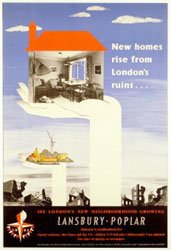
This 'aberration' is an open, unfinished project, in that it involved the jostling of two forces, one of which came out quite definitively on top. Accordingly, the rhetoric of the period- Wilson's 'White Heat of Technology' now appears as a smokescreen for a society already gearing up to return as quickly as possible to the past. So much rests on what didn't happen. What if Thamesmead or Cumbernauld had been welcomed as modernist communities by their inhabitants, and had provided models for the rest of the country? What if the BBC Radiophonic Workshop were more important than the Beatles?

Hence the evocation of raving at the Festival of Britain, one of the many possible beginnings that became dead-ends in the 45-79 period- a modernist utopia on the South Bank, torn down by Churchill in 1951 as 'three dimensional socialist propaganda' and replaced with the capitalist realist, proto-pomo Shell Centre. Or think of the films of Powell and Pressburger (particularly A Matter of Life and Death promising an England matter-of-fact at its own strangeness, acknowledging its imperialist past and becoming a forward-looking, European technicolour social democracy, rather than a more cramped, meaner-spirited America.
posted by owen hatherley at 2:55 pm



3 Comments:
f-ing good post, owen!
*fairly* sure where michael powell stood viz. the 'aberrant' years, though.
owen it's an amazingly short-term perspective isn't it, the idea that 'laissez faire' economics define the whole of british history pre-1945...
is it? why? it's a generalisation, sure, but the UK was pretty conspicuous compared with other rich industrialised countries for its financial conservatism even in the 19th century. hence the utter lack of infrastructure and investment in public services by business compared with say, Germany under Bismarck. This gets especially cruel and glaring in the 20s and 30s, obv. Naturally there's all manner of showy Victorian philanthropy, but I don't think that deserves to be taken seriously. But perhaps you do- if so, do tell...
re: powell- i always think of the bit in AMOLAD on the phone at the start- 'conservative by inclination, labour by experience!"
Post a Comment
<< Home