In which we storm the Winter Palace

The Lunatic Asylum
Obviously it doesn't make it a healthier country or a more pleasant one to live in, but my north-west European eye is immediately pleased by the closeness of industry and urbanity in Russia. You can take a leisurely stroll from submarines to neoclassical institutes here, and that is as it should be. And despite the grimness of Russian politics, there must be something promising about a society in which work is not hidden away coyly on the edge of the motorway. Of course, there's lots of the latter here too, and perhaps it's just a work-in-progress, and one day all this will be elite apartment blocks.

Regardless, today you can walk along the canals and find buildings like those above and below facing each other. Any architectural authorities who can give me a clue about this, adjacent to the shipbuilding works, please do. It looks '20s, and gives off a strong smell of polish.

This is residences for employees of the shipyards, executed c1908 in what they called here Style Moderne, by Alexander Dimitriev, who we will come across again later. You can see it is covered in a thin layer of grime and dust, as is almost everything in St Petersburg, from the buildings to the cars. For all its grandeur and order, this is not a fastidious city, or, at least to the untrained eye, a rich one; you sense it's a very, very long time since this was the Russian capital, and although many in the current Gazprom/United Russia hierarchy come from here, their Gazprom tower proves they want to make their hometown as much like Moscow as possible.

The proximity of these different registers coincides with a seeming carelessness about which parts of it get restored and which don't. So you find places like this, rotting away quietly, in no better a state than the remains of Leningrad constructivism.

The ruination extends to our venue, our pretext for being here - a conference on the Politics of the One, a curious melange of phenomenological musing and activism - the latter maybe is advisedly hidden by the former, although a post-conference multilingual rendition of the Internationale makes abundantly clear where sympathies lie. The conference takes place in an area dominated by Petersburg's main lunatic asylum, to the point where apparently this is shorthand for the area in general. The streets around are akin to Berlin's Prenzlauer Berg, tall imperial tenements along wide streets, only there's not a vintage boutique or yummy mummy (what is this in German?) to be seen; or, indeed, many actual people. The building below is where part of the conference took place, the Institute of Arts and Sciences...

...where, it pleases me immensely to truthfully report that someone left a cake out in the rain. I don't think I can take it - it took so long to bake it, and I'll never have that recipe again.

Narvskaya Zastava/Kirov District

This, however, is the very Constructivist heart of Petersburg, perhaps the largest scale deployment of the Russian avant-garde in designing an entire area, at least outside of the (still-semi-secret) new towns of 1930. From 1924 onwards, this district - centred around the Putilov Works, which provided the bulk of Bolshevik support in the revolution and civil war - was replanned as a showpiece of the new society then apparently in progress. The only building here that really gets mentioned in the guidebooks, though, is above - the Narva Gate, built to celebrate victory over Napoleon and to provide a gateway to the city. This photo is also about as much of the Metro system as I dared photograph; it is less than a week after the Moscow Metro bombings, and the Militia are everywhere, and I hadn't 'registered' my visa by this point... Here's what the station looks like behind me. It was intended to be named after the square it faces - Ploshchad Stachek, Strikes Square; but became Stalinskaya, then Narvskaya.

The area, then, is either defined by the 1810s or the 1920s, depending on your politics. The pomo shopping mall above, the only major post-50s building in the area, has no doubt where it stands on this issue. Mirror-glass, columns, some granite-ish substance, hint of imperial revanchism - it's all there, and the 1990s were clearly every bit as catastrophic for architectural literacy as they were for life expectancy.

It faces the Gorky Palace of Culture. This was designed c1925 by two of the most prolific Leningrad Constructivists, Alexander Gegello and Dimitri Krichevsky, borrowing much of their plan from an earlier design by erstwhile art nouveau designer Dimitriev. It is postconstructivism before constructivism, a mid-point between the classical and the modern achieved before the modern got much of a chance. Its massiveness coincides with lots and lots of glass, and a lack of explicit historical reference. It abuts this:

It's a Furniture Store designed around the same time by the same architects, which was when built a Technical College. In the original drawings, this is a ribbon window with a proto-Libeskind upwards slash - evidently the builders took one look at that and swiftly revised it to its current classico-constructivist melange. As well they might, given the somewhat limited technical abilities of the time.

The mural - which, with its hint of expressionism we assume to be either pre-1932 or post-56, but Thomas says is probably 60s or 70s - immortalises the Narvskaya proletariat, its industry, its strikes and so forth; whether the regime at the time would have been so keen on actual strikes is another matter, but this is one of its better artistic remnants - no giant supermen, no bulging muscles, a vision of energy rather than oppressive solidity, with a detectable trace of fire to it.

It's not really a Square, Stachek Square, it's a large traffic space attached to Stachek Prospekt, another long, wide street, which may once have felt public when the traffic was minimal, but now - perhaps as intended - feels far more of an artery than a public utility. The buildings don't feel as unified as they might, as to cross the road to get to them involves a certain amount of bravery, even on this cold Monday morning. Above is the (recently restored, though not in the original colours) School for the 10th Anniversary of the Revolution, designed by Alexander Nikolsky, a pupil of Kasimir Malevich. It's planned, arbitrarily but prettily, as a hammer-and-sickle. In the hammer, you can see another set of insignia added to the familiar:

But the most striking thing in Strikes Square is a building in far worse condition than any of the others - the Kirovsky Fabrika Kuchina, or Kirov District Factory Kitchen - after having him bumped off, Stalin had the entire area renamed after his comrade/rival. The sign at the top says 'Kirovsky Univermag'.

This is an incredibly ambitious building, perhaps the most brilliant and fearless of the three designed by ASNOVA architects (keep up!). On each side are huge plate glass windows, in the middle is one extremely long hyper-Corbusian ribbon window, and beneath it, are the angular glass windows of a department store; perhaps this didn't go down well in the Petersburg climate, but the actual fabric of the building seems fairly untouched - the originality and confidence of design is still astonishing, but logos have been bolted onto every available surface, and the concrete is clearly in dire need of repair. The roof terrace is now a green pitched roof.

There's a real cruelty about the renovations of Constructivist buildings. Let's stick a McDonalds in an experiment in socialist living, ha ha ha. I'm sure it's ignorance rather than deliberate obnoxiousness, but it's hard to tell the difference.

We did have a very nice meal in one corner of it, which was selling Russian specialities. Among the very few phrases I know in Russian are Shashlik, yes, no, thank you, and dictatorship of the proletariat.

Perhaps the most surprising and all-round wonderful thing on Stachek Prospekt is the Traktornaya Ulitsa housing scheme, by Gegello, Krichevsky and Nikolsky. It forms the basis of a thing on Russian architecture in the New Humanist, out nowish (shameless plug over). It's the first major housing scheme completed in the USSR, and quite remarkably pretty.

Petersburg classicism gone cubistic, opened up, chopped up only seemingly at random, without the divide between the imposing front and the sordid backside that defines actual Petersburg classicism. While other compromises between Constructivism and classicism are just that - compromised, caught inbetween two styles, leading to intriguing confusions - this scheme has total confidence about itself. It does many of the things that 70s/80s community architecture and residential pomo would try and do - a teasing morphing of a familiar local 'vernacular' (how I hate that phrase - for serious want of a better word) into something palpably new - only, for reasons both political (i.e, an unsurprising lack of nostalgia for Tsarism in early Bolshevik Petrograd) and aesthetic (Petersburg's 'vernacular' is not remotely woolly or provincial) it actually works. Of course, it's as neglected as everywhere else, but wears the knocks well. Notice lots of the fridge/balconies.

On the other side of Stachek Prospekt is some - presumably late '20s - minimalist Zeilenbau housing, nice enough, but the pre-Corbusier avant-garde certainly wins out here...

The largest of the Stachek Prospekt buildings - and, when it was built in 1932, perhaps the largest of modernist buildings anywhere, here or elsewhere - is the local town hall, or again, post-assassination, Kirov District Soviet, designed by the aforementioned Noi Trotsky, near-namesake of the similarly assassinated former leader of the Petrograd Soviet.

There will be a large chunk of PhD about this place, which made my attempts to get a decent shot of it especially frustrating. It's a very long ribbon-windowed block in concrete and granite, with, on one side a Mendelsohnian cruiseship corner and on the other, a Constructivist tower with an illuminated hammer and sickle. Hence, it's probably the best building ever. Note that viewed from the square, the chimney of the Putilov Works is symmetrically aligned with the Soviet.

On the other side, is what happened to architecture after 1932, and it's unclear which the unfortunate Kirov is gesturing to. Apparently, the plinth has the man saying something rather cosmic - any Petersburgers want to add it in the comments? I failed to take notes.

Click on these two to make them larger and you will notice two versions of the hammer & sickle, the straight-up red-illuminated one, and another, presumably later one with all manner of heraldic frills, foliage and halos on it.

Round the back, an extension by N. Trotsky, including the 'Progress Kino' - oh yes - got the Postconstructivist treatment, with mouldings added on for no perceptible reason. It's either being renovated or is the subject of an elaborate architectural joke.

The back end of the Kirov District Soviet is unnerving. I suspect this bridge was some sort of fancy Dessau bauhaus glass thing in the original renders. The office adjacent is the draft board. Young Petersburgers, dodging the draft into a notoriously brutal army, tend not to get the Metro, as it's always crawling with Militia - who can legally kidnap them, take them here, and force them to enlist. Most likely, it was ever thus - although a loophole for University students has been closed recently.


Two final things in Narvskaya Zastava. Thomas pointed us to the local park, where there is - faintly, if you squint - the only surviving graven image of Joseph Stalin on permanent display in a public space in any major Russian city, after they were cleared out in the early '60s. Moscow Mayor Yuri Luzhkov intended to rectify this for the 65th anniversary VE day celebrations, but that was a step too far, for the moment.

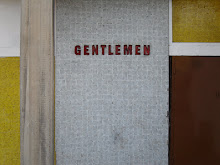
Finally, the lettering here tells me this might be Constructivist, but historical likelihood tells me otherwise - but either way, the Socialist Lavatory League warmly applauds, and the lens flare offers an appropriately utopian, sun-saturated accent.

Tsentralnaya
There is only one Constructivist building in the centre of Leningrad - the Bolshoy Dom, the Big House, housing the NKVD, the GPU, the OGPU, the KGB, and currently the FSB, which means it's in better condition than any building of its era, here or in Moscow. It was designed by Trotsky and Gegello, and it is a rare example of Constructivist architects - very talented ones - applying modernist principles directly to the instruments of dictatorship, with much minimalism, plate glass and Americanist/Bauhaus references. The repetition and scale of the central part of the building, though, is pure Lubyanka. Lang Rabbie warned me against taking pictures, so I waited until the troops hanging round the area weren't looking, then walked briskly in the other direction. On reflection, this may have been potentially very stupid.

Apart from the Metro stations, there's very little Stalinist architecture here either. There's just a smattering of Putindromes, too - but when they're here, they're as appalling as anywhere else. This is 'Regent Hall', a daring assemblage of columns, mirrorglass and supergraphics:

This building was finished in 2008. Terry Farrell, Michael Graves, Charles Moore, this is distantly your fault, and the revolutionary tribunal will not forgive you.

Like Moscow, Petersburg suffers from 'sham replicas' - the destruction of buildings and the reconstruction of their façades over new concrete office or apartment buildings - above is one in progress.

But unlike Moscow - or Warsaw, or indeed London - ads are not as offensive a plague as they could be. In the Metro, ads were installed on the escalators for the first time very recently - but there wasn't enough demand for all the advertising space to be utilised, so optimistic looking images fill the unused slots - cats, flowers, and historic buildings. And here is one of a series of Gazprom posters all over the ex-capital - with impressive gall, they proclaim how Gazprom is preserving heritage, tradition and whatnot, presumably by ensuring that St Petersburg have its UNESCO World Heritage site status taken away from it.

Nonetheless, even given Gazprom and the horrendous traffic, sometimes the city feels unbelievably untouched. I'm staying on this street, looked over by Pushkin...

...and inside, many apartments are still subdivided as kommunalkas - the multiple doorbells are apparently the tell-tale sign.

The contribution of St Petersburg to town planning is the link between massive wide-street-boulevard and massive wide plaza - here I realised where Karl-Marx-Allee, Marszalkowska, the entire school of Soviet neoclassical planning, something which I find endlessly ambiguous and fascinating, actually comes from - not an original creation of Stalinist architecture itself, but of the pre-revolutionary Tsarist capital. These spaces are planned for military purposes, but all too often become the site for insurrection - the July Days and the storming of the Winter Palace in 1917, the uprising on the Stalinallee in 1953, the demonstrations on Alexanderplatz that killed the DDR. The street is Nevsky Prospekt, the square is Dvortsovaya Ploshchad. The sign above is on the former.

Nevsky Prospekt was clearly once ultra-modern, and the government/Gazprom want it to be so again, on similarly absolutist terms. The Dom Knigy above is, along with Kazan Cathedral, the street's most breathtaking building (with very stiff competition), the finest of its Jugendstil buildings we come across. It was originally the showrooms of the Singer sewing company, who displayed their workers in the window at night, using the sewing machines for the edification of the promenaders. Textile workers had a hand in the Russian revolution, and one wonders if being made a living window display was in the mind of some of the women who kicked it all off, on International Women's Day in February 1917...

The most interesting window display on Nevsky Prospekt is, however, this. This is what they think of us. After my occasionally stereotyped musings on eastern Europe, this is richly deserved.

Several men dressed as Peter the Great fail to court the minuscule amount of tourists, and go for serenading the wedding party in the corner instead.

There's some similar tomfoolery in Dvortsovaya Ploshchad too, but it makes little difference. This is pure New Town planning on an unforgiving scale, more so than anything in the 20th century - no seats, no 'street furniture', no jugglers, no coffee concessions, no sets of chairs and tables with overhanging parasols or awnings - just the sheer experience of space, giant, thrillingly empty space, spread out for your contemplation. Received opinion says these spaces are politically oppressive, but received opinion is full of shit on this matter. The entire entity was so centralised that taking it out was achieved with a great deal of ease in October 1917. Looking at how this space was turned against itself, we have to wonder if the decentralised spaces of power today can ever be 'taken' in the same way. But if you ever go to an out-of-town business park, you'll notice plenty of space. 'An empty space', writes Ivan Chtcheglov, 'creates a richly filled time'. It's also a space which can be filled with something more than time. The Winter Palace is about the only place where you can sit, on the corners of the columns.

posted by owen hatherley at 2:20 pm



5 Comments:
The same paradox played out everywhere; after the 1848 revolution, Vienna got rid of the city walls and built the Ring on their footprint, very much in a Haussmann effort to move troops into the city (the first major buildings on the Ring were the Rossauer barracks and the church that served it) and to prevent rebels fortifying themselves in the city again.
But the new boulevard turned out to be a perfect theatre for mass protest, as the Social Democrats replaced the National Liberals as the major threat to the authorities. (I recall from my time there that it's still a really great place for a demo, whether you're planning to march down it, block it and hold a public lecture, or throw an illegal rave on it.)
Just thought I’d drop you a line to tell you your site really rocks! I have been looking for this sort of information for a long time.. I don’t usually reply to posts but I will in this case. WoW terrific great.
Strasbourg hotels
I'm a runner, like running barefoot!
I think I just learnt few things new here. Don't know much about culture and history. I am blooger and currently blogging on portable dvd player reviews
Good Article, souvenir resepsi pernikahan termurah. thanks for your article. :)
Post a Comment
<< Home